
















In this guide
The short version: choose a 4-channel amplifier to power your door speakers, a mono amplifier for a subwoofer, and match the amplifier's RMS output to your speakers' RMS handling. Get those three things right and almost any modern Class D amplifier will transform a factory-fed system.
Here's how to work through it properly.
Do you actually need an amplifier?
Factory head units and most aftermarket stereos produce roughly 15–20 watts RMS per channel in real terms. That's enough for background listening, but it runs out of clean volume quickly — turn it up and you hear distortion, not detail. A dedicated amplifier gives your speakers the current they were designed for, which means more volume and less distortion at every level. If you've upgraded your speakers and they still sound flat, the amplifier is almost always the missing piece.
Channels explained: 2, 4, 5 and mono
4-channel is the standard choice — front and rear speakers, or front speakers with the rear pair bridged to run a subwoofer. A compact example is the Option Audio AIR-D4 (330w RMS, £179).
Mono (1-channel) amplifiers are built for subwoofer duty — high current at low frequencies, with bass-specific controls like a low-pass filter and subsonic filter.
5-channel combines both in one chassis: four speaker channels plus a sub channel. One power run, one fuse, tidy install.
6-channel suits active setups where tweeters and woofers get their own channels — the Option Audio AIR-D6 (£249) is a good compact route into active running.
Power matching: RMS is the only number that matters
Ignore peak and "max" figures. Match the amplifier's RMS output per channel to your speakers' RMS handling — a little over is fine (clean headroom is safer than a small amp driven into clipping). A speaker rated 75w RMS is happy on an amp delivering 60–100w RMS per channel. Impedance matters too: check your speakers' ohm rating against the amp's rated load, and never run an amplifier below its minimum stated impedance.
Class D and where to put it
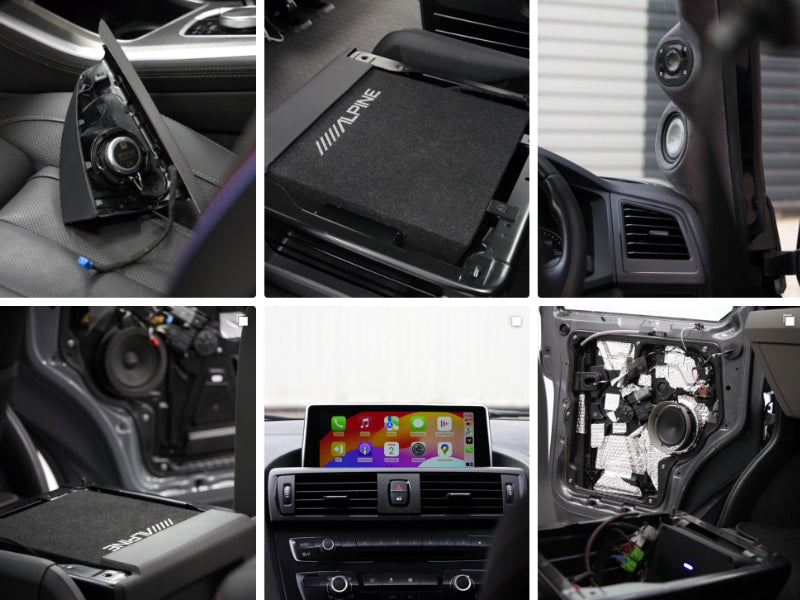
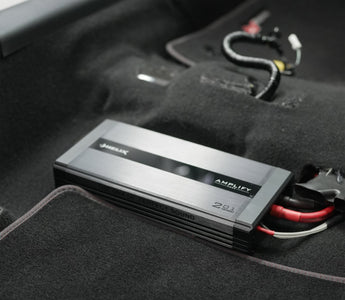
Modern Class D amplifiers run cool and compact — small enough to mount under a seat — which is why they dominate the market. Allow airflow around the heatsink, keep power cable runs sized to the amp's fuse rating, and route RCAs away from power cables to avoid noise. If you'd rather not run cable through the car yourself, we offer professional amplifier installation from our Nottingham premises.
Frequently asked questions
Do I need to change my head unit to add an amplifier?
No — a line output converter takes the speaker-level signal from a factory stereo and converts it to a clean signal an amplifier can use. Aftermarket stereos usually have RCA pre-outs built in.
What does bridging an amplifier mean?
Combining two channels into one more powerful channel, usually to drive a subwoofer from a 4-channel amp. Check the bridged power rating and minimum impedance before doing it.
Can CEN supply everything I need in one order?
Yes — amplifier, wiring kit, RCAs and speaker cable. Tell us your speakers or subwoofer and we'll match the amplifier and wiring for you.
Written by the CEN team in Nottingham — car audio specialists for over a decade. Questions? Contact us or call 0115 924 0666.

