












In this guide
The quick answers: a pair of front doors takes around 1 to 1.5 square metres of deadening; a thorough full-car treatment runs 4 to 6 square metres depending on coverage. Start with the doors — they give the biggest gain for both road noise and audio quality — then the boot floor and wheel arches. And it's one of the most DIY-friendly jobs in car audio: cut, peel, stick, roll.
Why deadening is secretly an audio upgrade
Sound deadening does two jobs. The obvious one: butyl sheets add mass to thin steel panels, so road roar, tyre noise and vibration stop reaching the cabin — the car simply feels more expensive to drive.
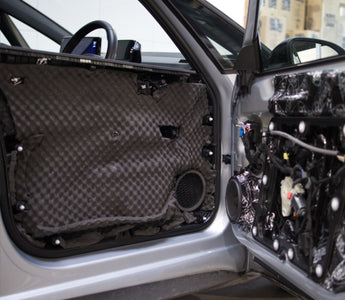
The less obvious one is why installers fit it with every speaker upgrade: your door is your speaker enclosure. An undeadened door panel flexes and rattles with every bass note, throwing energy away. Deadening the door skin turns a vibrating panel into a solid enclosure — speakers you already own produce cleaner, tighter bass immediately. If you're choosing between slightly better speakers and deadening the doors, deaden the doors. (Then read our speaker guide.)
Where to apply, in order of payoff
- Front doors — the audio and noise double win. Outer skin first, inner skin if you're being thorough.
- Boot floor and wheel arches — the main road-roar entry points, and essential around a subwoofer install.
- Rear doors and quarters — completes the cabin.
- Floor pan and bulkhead — the full-treatment stage for motorway-mile cars and vans.
- Bonnet and roof — marginal gains, worthwhile mainly on vans and camper conversions.
Fitting it yourself
Panels come off with plastic trim tools; the metal gets a wipe with panel cleaner; sheets are cut to shape, peeled and pressed on; then — the step that separates good installs from peeling ones — rolled down hard with a deadening roller until the foil takes the panel's shape. Aim for 60–80% coverage of each panel; total coverage adds weight faster than it adds benefit. Allow an afternoon for a pair of doors.
Rather not? CEN fits sound deadening from our Nottingham premises, usually alongside speaker and subwoofer installs when the panels are already off — the efficient moment to do it.
Which brand?
- Dynamat — the name that defined the category; Xtreme remains the benchmark butyl sheet.
- Skinz — excellent performance per pound and our most popular for audio.
- Comfort Mat — premium multi-layer materials for refinement-focused builds.
- Dodo Mat — the UK value favourite, ideal for full-vehicle and camper projects.
All four work the same way; thickness, layer construction and price per square metre are the real differences. Sheet coverage is listed in each product's Specification tab.
Frequently asked questions
How much sound deadening do I need for a pair of doors?
Around 1–1.5 m² covers both front doors' outer skins properly. Add the inner skins and you're nearer 2–2.5 m².
Does sound deadening make a car noticeably quieter?
Yes — doors and boot treatment takes the edge off road roar audibly, and the doors close with a satisfying premium-car thunk.
Will sound deadening affect weight or fuel economy?
A full treatment adds roughly the weight of a passenger's bag — irrelevant to economy in practice.
Is one sound deadening brand really different from another?
The chemistry is similar; construction differs. Thicker multi-layer products deaden lower frequencies better but cost more per metre. A quality mid-range sheet fitted well beats a premium sheet fitted sparingly.
Written by the CEN team in Nottingham. Browse the full soundproofing range — and if you're planning speakers at the same time, ask us about doing both together.

