










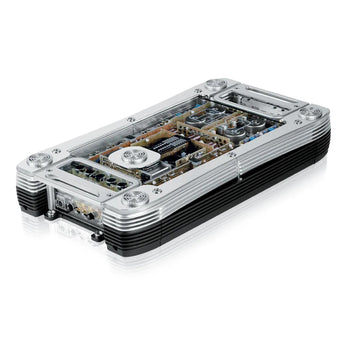
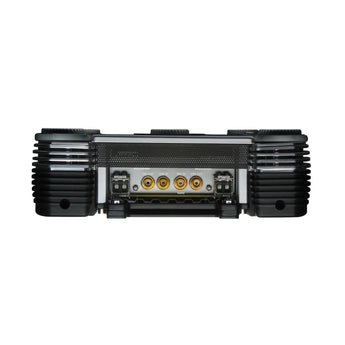
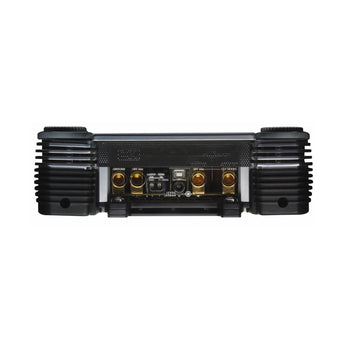
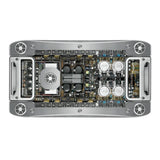
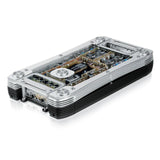
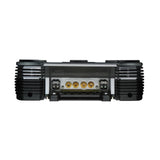
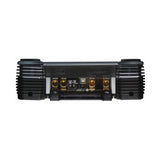
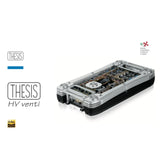

Audison Thesis HV Venti Amplifier Class A 2 Channel Dual Mono Amp 1600w RMS
Couldn't Load Pickup availability
HV venti
Amplifier | 1600 W total power | 2 x 800 W @ 2ohm | A-class
"The Amplifier"
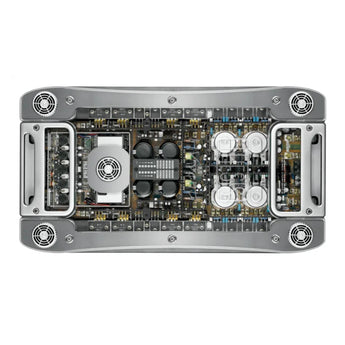
Absolute lack of compromise in achieving maximum performance is the mantra followed by the Audison R&D for the HV venti, a project with unique features. The total void of integrated operational circuitry allowed the engineers to work at higher voltages and with a Class biasing of the intermediate stages.
- Exclusive circuitry IGBT (Insulated Gate Bipolar Transistor).
- A Class preamplifier, intermediate stages and drivers.
- Dual Mono construction featuring four power supplies in Synchro-PWM
- configuration.
- Made exclusively with discrete components.
- Signal switching made exclusively with relays.
- Fully balanced input circuit.
- Power supply on separate board to eliminate interference.
- Dual Power’ function to switch between Hi-Current and Hi-Power.
- Bias Selector’ function to change the percentage in A Class.
- High quality crossover module supplied.
- 5 mm aluminium chassis connecting two side cooling ducts.
DUAL MONO CONSTRUCTION
Four Synchro-PWM power supplies allow a very fast transient current response and create a Dual Mono configuration.
MOSFET-BJT HYBRID CONFIGURATION
HV venti employs a unique output power stage topology, discrete IGBT, made by two Hitachi DMOS driving two pairs of complementary Sanken power BJT, each rated for 30A peak current and 200 W dissipation.
A-CLASS PREAMPLIFIER AND DRIVER
It is made of two groups, Front End pre-amplifier and control unit. The whole stage is balanced up to the driver outputs. The power supply voltage is 90 V and is specific for this stage and dedicated to the two separate channels. The separate 150 V power supply is thermally stabilized and A Class biasing. Input is balanced with the first stage, complementary JFET differential and the second stage, complementary BJT differential. The voltage amplifier is Cascode type with a buffer to drive the output stage.
Specification
| Channels | 2 |
|---|---|
| Bandwidth A (-3 dB, 2 VRMS, 4 Ω) | 4Hz ÷ 75 kHz |
| S/N ratio A (A weighed @1 V) | 100 dB |
| Damping factor A (1kHz, 4 Ohms) | 80 |
| • 2 Ch | 800 W x 2 (2Ω) |
| • 1 Ch | 900 W x 1 (4Ω) |
| Input Type Pre IN | L/R (ABS) |
| Weight | 15 kg |
More specs
| |
What's Included
- Audison HV Venti
FAQs
Q: How do I choose the right amplifier for my speakers or subwoofer?
A: Match the amplifier's RMS output per channel to the RMS handling of your speakers or subwoofer at the same impedance. The Specification tab lists the power figures. If in doubt, contact CEN with your setup and we will recommend a match.
Q: What wiring do I need to install this amplifier?
A: You will need an amplifier wiring kit sized to the amplifier's power draw, typically including power and earth cable, a fuse, RCA leads and a remote wire. CEN stocks complete wiring kits, and the amplifier's fuse rating is the guide to the cable gauge required.
Q: What class of amplifier is this and does it matter?
A: Class D amplifiers are compact and efficient, ideal for subwoofers and modern installs. Class AB designs are traditionally favoured for outright sound quality on mid and high frequencies. The class is listed in the Specification tab where provided.
Q: Will an amplifier work with my factory head unit?
A: Yes, in most cases. If your head unit has no RCA outputs you will need a line output converter to feed the amplifier a clean signal. CEN stocks line output converters and can advise the right one for your vehicle.
Q: Can CEN install this amplifier?
A: Yes. CEN offers professional amplifier installation from our Nottingham premises, including secure mounting, wiring and setup. Contact us to book.
About the brand
Audison
Recommended For You
Discover more top-rated gear, handpicked to go with what you're viewing


Looking for Installation?
At CEN we take pride in being able to share the quality of our work as well as being able to show what incredible products we have installed week on week.
Elettromedia Brands
Evolution of technology and art of sound